
Passover

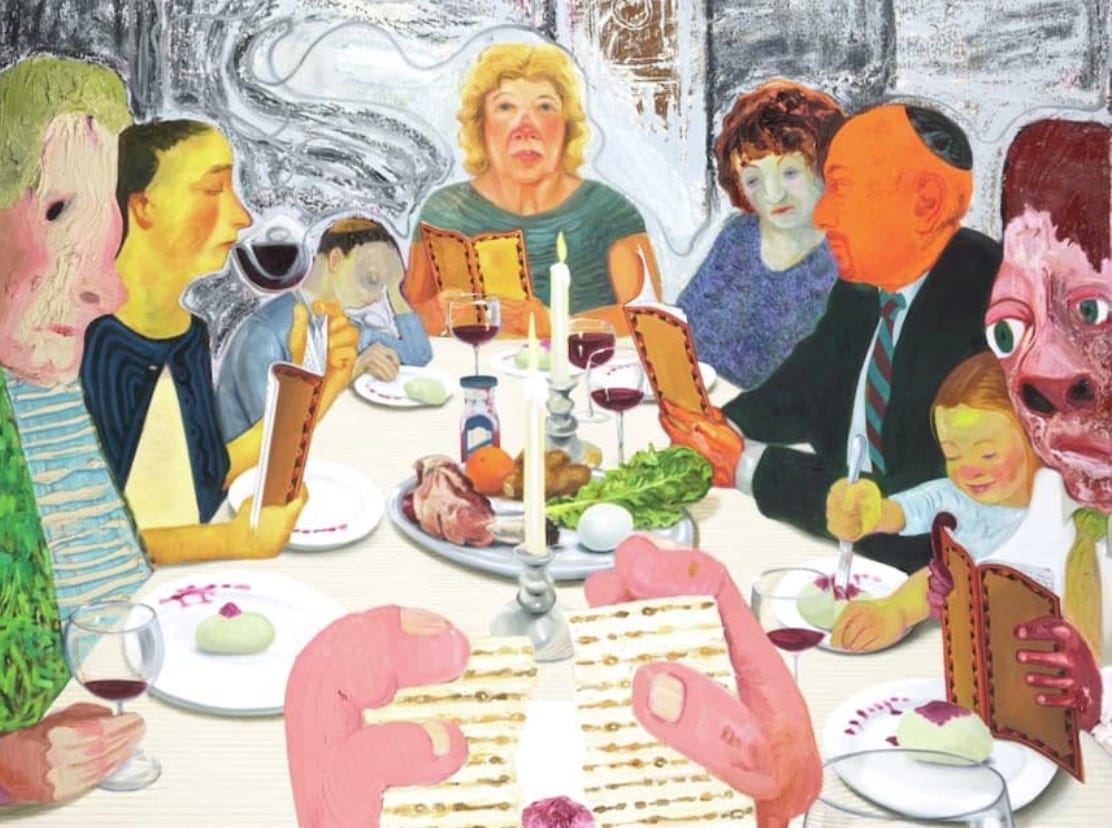
Nicole Eisenman (American, b. France, 1965), Seder, 2010, oil on canvas, 39 1⁄16 × 48 in. The Jewish Museum, New York.
Passover in NYC: winter is reluctantly making an exist, white and pink magnolia flowers are in bloom against the grey sky. This year winter overstayed its welcome and Passover came early. It seems like Spring is trying to find its way, only to be thrown aside over and over again by cold winds and grey days. There are no tulips yet. I did spot two snow fountain weeping cherry trees among the concrete along the FDR. They were covered in white blossom falling down an elegant structure of branches like water falling in arches. It does look just like a miniature fountain!
Almost five years ago, I drove up the FDR with heavy contractions on a hot summer day. Every time I find myself heading uptown, I can only remember being in that car, both fearful of an unknown pain I was starting to endure and at peace knowing I was about to meet my child, while looking out the window and seeing people go about their daily lives.
Passover is a holiday meant for children, it is how we teach the next generation where they come from, what their ancestors believed in, and what their ancestors endured. It is a moment of story telling. It is also a moment of reckoning of where we stand, whose shoulders we stand on, what values make up the fabric of our beliefs. It is a moment of hope and togetherness.
Every year, I turn to Marge Piercy’s poem Maggid which so beautifully captures the stories we tell one another, as oral history, as shared collective memory.
So it begins:
The courage to let go of the door, the handle.
The courage to shed the familiar walls whose very
stains and leaks are comfortable as the little moles
of the upper arm; stains that recall a feast,
a child’s naughtiness, a loud blattering storm
that slapped the roof hard, pouring through.
I love the opening line of this poem, the courage to let go of the door, the handle, as if visually describing that act of letting go, as if we follow her eyes, her hand. It is all the more powerful that semantically passover refers to the Angel of Death in the Exodus carrying the Tenth Plague (the death of all newborns) who would pass-over the doors that were tainted with the blood of a lamb, as instructed by God to Moses to protect the Israelites. There are a lot of doors in the Passover rituals. Doors for protection, open doors of hospitality to strangers and those in need.
When my daughter was just born and we took her home, I learned to swaddle her and gingerly place her in her cot and carefully walk out of the room where she slept. After half closing the door, I would place my hand on the wooden door and say a little prayer. I still feel under my palm the warmth of the wood. I placed my hand there so many times as she slept.
And now she is big enough to look for the Afikomen and hold the hand of our friend’s toddler, showing him some game she has invented or toys she has discovered. It is time for me to let go of the door, of the handle.
Our neighbors’ daughter went off to college. They gave us the wooden bed they had made for her room which is the exact size of our daughter’s room. Now my child does not sleep in a cot, or a toddler’s bed but a bed that she might use till she too goes to college. I can’t quite think about that. But I see our neighbor’s daughter, a wonderful young woman, who loves to dance and is currently spending a semester abroad. And I know that when my daughter goes to college, I will put the palm of my hand on the door of her bedroom at home and think of those nights when she was a newborn and I will say those same words in my head, feeling the warm wood under my palm because words that we repeat over and over again, like questions we ask year after year, are the stories we tell ourselves in order to live and keep each other safe.